paligemma2-detection
Paligemma-2 Open Class Object Detection Evaluation
As naturally open class detection models, Paligemma-2 models need a special evaluation protocol for a closed-set detection benchmark like COCO2017.
Prediction Building Protocol
- classes_per_call is set to an integer between 1 and 80
- 80 COCO classes are divided (evenly when possible) into groups, each containing classes_per_call classes
- For each group with a set of class names c_1, c_2, … , c_{classes_per_call}, a prompt is constructed as follows:
- detect c1 ; c2 ; … ; c_{classes_per_call}\n
- The resulting prompt is sent to the model along with the input image. The model outputs a set of bounding boxes in the format:
<locXXXX><locXXXX><locXXXX><locXXXX> class_string ;- Typically (as expected),
class_stringmatches one of the classes c1,…,c_{classes_per_call} - <locXXXX> is a special token type used by Paligemma-2 models family to encode bounding boxes in the “XYXY” format
- XXXX takes values from 0 to 1023, inclusive, and represents coordinates relative to the input image sizes
class_stringmay consist of multiple tokens
- Typically (as expected),
- The prediction score is calculated as geometric mean of the probabilities of tokens within the
class_string - Predictions from all groups and all model calls are combined, and non-maximum suppression (NMS) is applied across all classes.
Example
classes_per_call: 5
The total of 80 COCO2017 classes are divided into 16 groups by 5.
- CALL 1 PROMPT:
detect person ; bicycle ; car ; motorcycle ; airplane\n - CALL 2 PROMPT:
detect bus ; train ; truck ; boat ; traffic light\n - CALL 3 PROMPT:
detect fire hydrant ; stop sign ; parking meter ; bench ; bird\n - …
- CALL 16 PROMPT:
detect vase ; scissors ; teddy bear ; hair drier ; toothbrush\n
All predictions (e.g. <loc0001><loc0123><loc0530><loc1012> stop sign) are then extracted
from all the 16 model outputs (which can naturally be imperfect and of arbitrary length).
Class scores (e.g. for class stop sign) are calculated as geometric mean of generation probabilities
of tokens in stop sign (e.g. a token for stop and a token for ` sign`).
In practice scores parsing implementation is a bit more complex because on the one hand it has to account for generation imperfections
(e.g. <loc0001><loc0123><loc0530><loc1012> truck ; <loc0031><loc0900><loc0127><loc1000> ; - with no class predicted for the second bounding box), structure breaks etc.
On the other hand the tokenizer itself may have its own rules set affecting the way how class_string
will be split into tokens and how their scores must be extracted.
Results
There is a number of interesting questions related to how Paligemma-2 models perform on object detection task. In the present work we’ll try to find answers to them.
- How does the
classes_per_callvalue affect the quality of detection? - How does the
mixseries of Paligemma-2 models compare to theptseries? - How is detection quality affected by the model size?
- How is detection quality affected by the model input resolution?
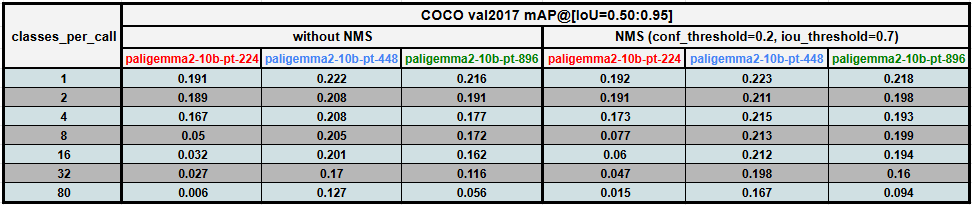
In all cases the COCO2017 validation mAP@[IoU=0.50:0.95] is used as object detection quality assessment metric.
Mix vs Pt
According to the official blog, “pt checkpoints are meant to be fine-tuned on a downstream task and were released for that purpose”, whereas “the mix models give a quick idea of the performance one would get when fine-tuning the pre-trained checkpoints on a downstream task”.
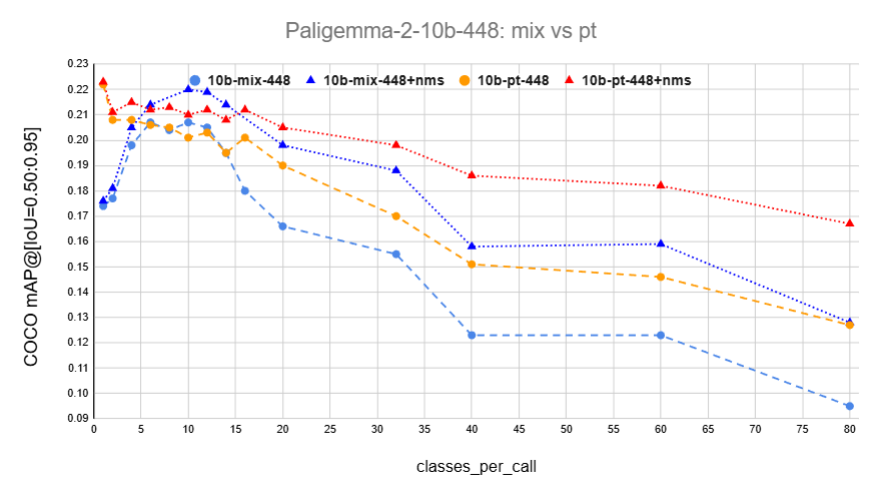
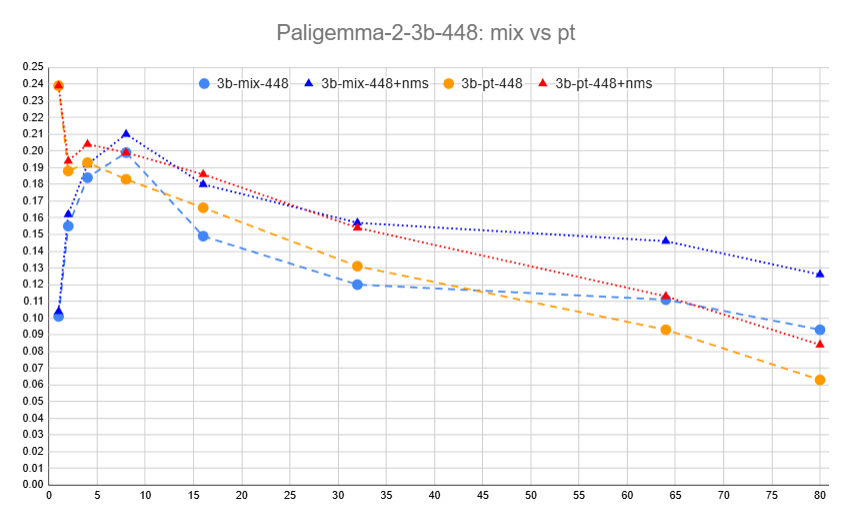
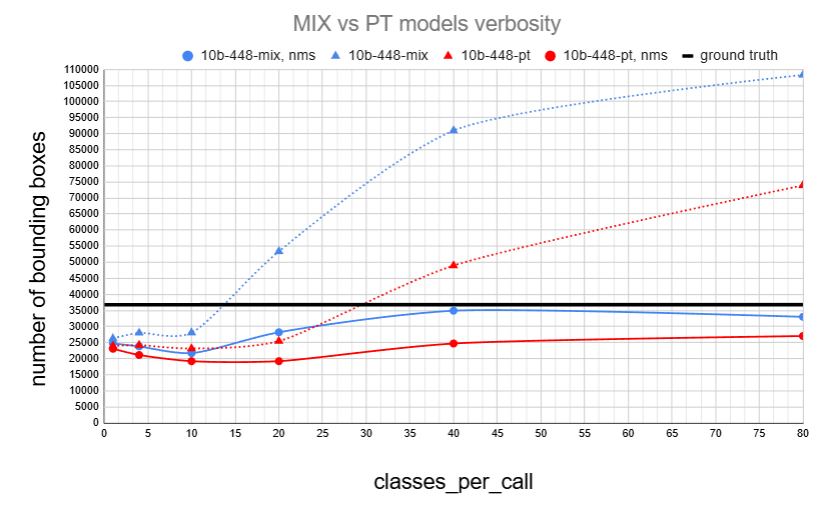
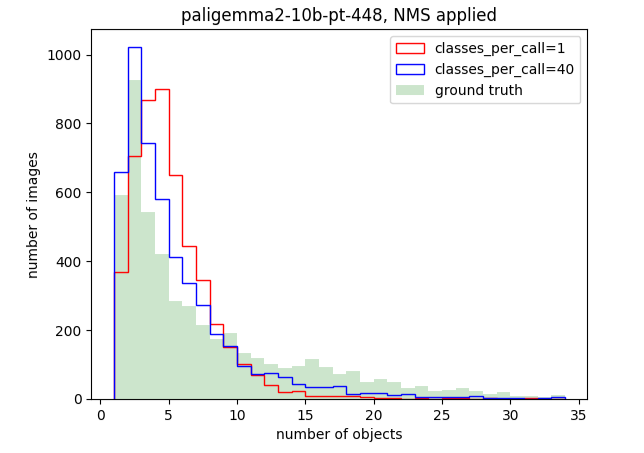
mixmodels appear to be more verbose thanptmodels- interestingly the detection quality of
ptmodels peaks atclasses_per_call=1whereas formixmodels, it peaks atclasses_per_call=10
Classes_per_call
- As the value of
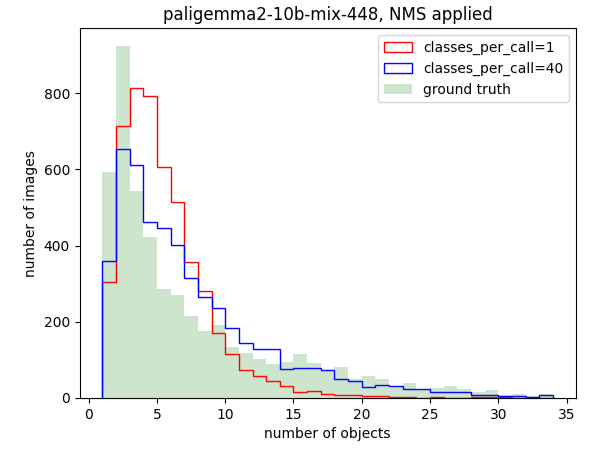
classes_per_callincreases, there is a tendency for model verbosity to grow- Longer text input is naturally correlated with longer output, so more detections are generated for more input classes
- Every single detection call with a large
classes_per_callbecomes more difficult for model to process, which leads to an increased risk of false positives and undetected objects - With a large
classes_per_calla lot of predictions are duplicated (the spread before/after NMS explodes)
Scores distribution
Model is usually pretty sure about the predicted classes as the 10th quantile is at 0.82 and the 20th is at 0.96.
Input Image Resolution
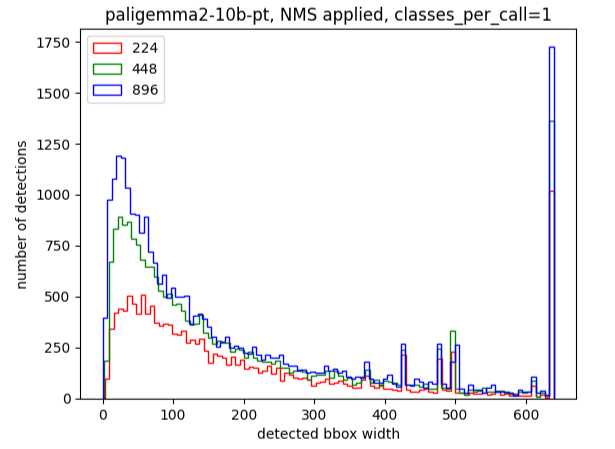
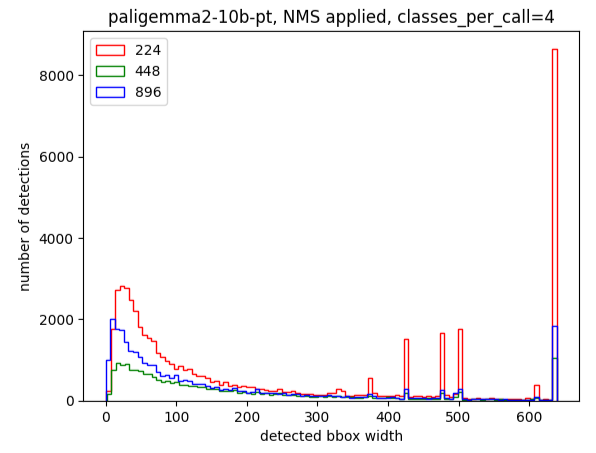
- As
classes_per_callapproaches 8, the10b-pt-224produces too many false positives (especially smaller objects), which degrades the metric- This could be because low resolution makes it difficult for model to distinguish between small objects types
10b-pt-896detects uniformly more smaller objects than10b-pt-448without significant performance degradation- The peak in detection size of 640 reflects another common behavior of Paligemma-2 models: when the number of objects of a certain type is significant, models tend to output the whole image as bounding box instead of detecting every single object of that type
Model Size

28B-pt-448model performs poorly on object detection task- According to the Paligemma-2 paper, “a possible factor related to the relatively worse transferability of PaliGemma 2 28B is that the underlying Gemma 2 27B model is trained from scratch, as opposed to the 2B and 9B models, which are distilled”
- In terms of open class object detection capabilities, the
10b-448model performs slightly better than the3b-448model